
Last December, Claudine Gallagher, Head of Securities Services and Patrick Colle, Executive Chairman of Securities Services and Chairman of Financial Institutions Coverage (FIC) business, sat down with l’Agefi, a leading French media group specialised in finance. In this interview, Claudine and Patrick discuss BNP Paribas’ Securities Services leadership transition, recent achievements and future priorities. Read the full article below.
Claudine Gallagher and Patrick Colle: “BNP Paribas’ Securities Services business ranks among the world’s top three in terms of growth”
Published in L’Agefi Asset Management on 18 December 2025
Interview conducted by Réjane Reibaud and Adrien Paredes-Vanheule
After fifteen years at the helm of BNP Paribas’ Securities Services business, Patrick Colle officially hands over the reins to Claudine Gallagher in January .
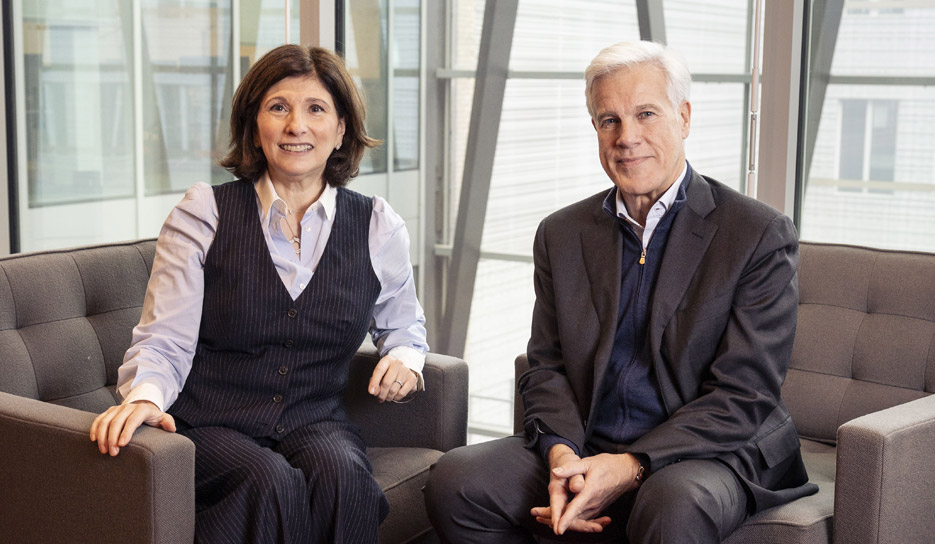
Claudine Gallagher, Head of Securities Services, BNP Paribas, and Patrick Colle, Executive Chairman of Securities Services and Chairman of Financial Institutions Coverage (FIC) business – REA
Patrick Colle, you are stepping down in early January 2026 after fifteen years as head of BNP Paribas’ Securities Services business. How do you look back on this period?
Patrick Colle – The year 2025 marks a double anniversary. It has been ten years since the Securities Services business was fully integrated into BNP Paribas’ Corporate and Institutional Banking (CIB) division. It has also been thirty years since the activity was created, notably following the acquisition of JPMorgan’s European custody activities. This year is also a solid one. If we offset the negative foreign exchange impact linked to the decline of the dollar, growth stands at more than 11% for the first half of 2025. This places us among the world’s top three in terms of growth for our business, based on comparable business models.
11%, the growth of the Securities Services business in the first half of 2025
Patrick Colle
Since the Securities Services business joined CIB, revenues have nearly doubled, while pre-tax profit has tripled. This represents an average annual growth rate of 6.5% over ten years.
Nevertheless, you remain fifth globally in terms of assets under custody, as you were ten years ago…
Patrick Colle – That is true if one looks solely at the metric of assets under custody. However, this measure does not fully reflect the nature of our model, which is unique in the industry as we are integrated into an investment and financing bank, highly diversified and present across the entire capital markets value chain.
In short, we operate simultaneously on both the buy-side and the sell-side. The buy-side brings us assets, while the sell-side, meaning investment banks, brokers, all trading-related activities, and so on, generates extremely high volumes of settlement activities for us.
In terms of asset custody, we rank fifth globally with more than 15 trillion euros. However, when it comes to settlement operations processed, we are looking at a potential volume of 200 million transactions this year. There is no ranking for this activity, even though it is structurally important. There is, however, an indirect indicator: Swift usage. We are the world’s second-largest user of Swift securities messages.
Finally, it must be said that the landscape has changed a lot over the past six years, consolidating significantly around the five largest players in the industry. Behind the idea of consolidation, I am of course thinking of acquisitions but also the ability to attract large clients. And we are very active on both fronts. This is illustrated by our recent acquisition of HSBC’s depositary bank activities in Germany and, one year earlier, of its hedge fund activities worldwide. On the client integration front, we have just won a strategic mandate from UniCredit Group to provide custody and settlement services to its entities in Italy, Germany and Luxembourg.
What are the key challenges for the industry stemming from this concentration of players?
Patrick Colle – It reinforces two convictions: size and integration have become decisive. A securities services business can be robust due to its size, but it becomes truly high-performing when it is embedded within a bank with a strong CIB franchise and a global relationship network.
When we joined BNP Paribas’ CIB division ten years ago, that was the first level of integration. Three years ago, we carried out a legal merger of the Securities Services subsidiary into the BNP Paribas Group. Today, we present ourselves to clients as a single bank, coordinating contracts, services and products from end to end.
Has this enabled you to capture new client segments?
Patrick Colle – Indeed, our business today is characterised by a broad diversity of clients: approximately 30% sell-side clients, 30% traditional asset managers, 25% asset owners, and 15% alternative managers. We have also established a global multi-local presence and a proprietary custody network across 27 countries, soon to be 28 with Canada.
A major growth drive over the past decade has been the rise of private markets and, by extension, asset servicing for private debt and private equity funds. Clients are often financial sponsors, but also managers launching private capital strategies. This activity has been growing at double-digit rates each year.
15 trillion euros in assets under custody worldwide
Patrick Colle
We have built an entirely new business, launched around seven years ago with the recruitment of a team of experts. Leveraging their experience, we developed a highly integrated and automated front-to-back platform, to which we added partnerships with BlackRock Aladdin, eFront, and fintech solutions, notably German ones (AssetMetrix, in which we hold a 23% stake). This platform connects general partners (GPs) and limited partners (LPs). Today, 1,200 Securities Services employees work exclusively on private capital services. We are approaching 1 trillion in assets under service for this activity, which places us – outside the United States – in first position among banking players.
Does this multi-asset model also extend to cryptocurrencies?
Patrick Colle – With regard to the digitalisation of assets, cryptocurrencies are not covered by the bank’s services and products. However, the bank is investing heavily in the tokenisation of traditional assets, particularly investment funds, with concrete initial initiatives and technological partnerships.
In October, we launched in Spain the first tokenised UCITS fund with real-time settlement, together with an asset management company called Azvalor. In August, we launched the first tokenised money market fund on Allfunds’ blockchain, with BNP Paribas Asset Management.
Could this “tokenisation” eventually reach the same level of revenue as the private capital business?
Patrick Colle – Ten years ago, there was a phase of euphoria around blockchain, then everything stalled. Recently, concrete use cases have begun to re-emerge, with broader cross-sector collaboration. By 2030, traditional and digital assets will coexist, and our role will be to eliminate operational boundaries between these universes.
We want to ensure a smooth transition for our teams and our clients
Patrick Colle
How do you intend to do that?
Patrick Colle – We are working on it; it is an ongoing project.
What does the integration of AXA IM into BNP Paribas change for the business?
Patrick Colle – For BNP Paribas, this transaction is extremely strategic, as it enables the creation of an asset manager with 1.5 trillion euros in assets, generating synergies across all of the bank’s businesses. BNP Paribas’ integrated banking model, of which Securities Services is one of the pillars, plays a key role in generating these synergies.
Claudine Gallagher, how are you approaching the technological challenges linked to the move to T+1
Claudine Gallagher – Before the United States moved to T+1, we had already successfully completed the transition to T+1 in India. Moving to T+1 requires a complete review of all upstream processes to ensure optimisation and automation. Shortening the settlement cycle to a single day has therefore further reduced the risk of settlement errors.
After some extensive preparations, the T+1 transition has gone very smoothly in the United States. Moreover, as we are the only non-US bank in the United States to be a fully equipped local custodian, with a direct link to the Federal Reserve and the Depository Trust & Clearing Corporation (DTCC), we took part in the relevant working groups. We also conducted a year-long client awareness campaign in advance. For Europe’s move to T+1 in 2027, we are already deploying a similar preparatory approach.
But Europe remains a much more fragmented market than the United States or India…
Claudine Gallagher – That is true, but the bulk of volumes flows through the Target2-Securities (T2S) platform. There will, of course, be country-specific differences, particularly for those not connected to T2S, but for us, the implementation of our T+1 programme will be the same. We have a central project structure as well as local project teams. We have already switched to project mode, with working groups in each country.
Where do the main challenges lie?
Claudine Gallagher – The entire front-to-back chain, from the investor initiating a transaction to the custodian, must be optimised. In my view, most of the work is not on our side, but on the clients’ side, where affirmation and confirmation processes need to be optimised. Otherwise, the risk is simple: instructions are not sent on time.
More than 1 trillion dollars in domestic assets – our U.S. local custody activity
Claudine Gallagher
Why establish a presence in Canada?
Claudine Gallagher – We have a local custody business in the United States that has just exceeded 1 trillion dollars in domestic assets, making us the fifth-largest player in the market. Our U.S. clients are expanding into Canada and want to find our services there as well. BNP Paribas has an expertise centre in Montreal employing 1,400 people. The objective is to offer our services to external clients there from early 2027.
Patrick Colle, you are becoming “executive chairman.” Why create this role?
Patrick Colle – To ensure a smooth transition for teams and clients. I will also remain sponsor of Financial Institutions Coverage (FIC). I will therefore wear two chairman hats, which allows me to remain available for Securities Services, while Claudine takes over the leadership of the business and drives its strategy. It is also the right time for this change, as the BNP Paribas Group prepares its 2030 strategic plan.
How do you see the future of Securities Services?
Patrick Colle – We want long-term client relationships, with a positive impact on the environment and on our teams. We involved our employees in shaping our vision for Securities Services, which we translated into actions and objectives through numerous working groups across all our locations. In total, 11,000 collaborators defined our vision, which incorporates sustainable growth and positive impact on society. This collaborative approach best prepares Securities Services’ contribution to BNP Paribas’ next strategic plan.
Claudine Gallagher, you are taking the helm of Securities Services on January 1. What will be your priorities for 2026?
Claudine Gallagher – I am returning to a business that is a BNP Paribas success story. In a constantly evolving market environment, our collective objective is to accelerate the transformation of Securities Services so we can continue to serve our clients in the best possible way, while giving our teams worldwide the means to further develop a culture of collaboration, responsibility and innovation.
This involves delivering end-to-end services within BNP Paribas’ diversified and integrated banking model, in the context of expanded client relationships.
Equally crucial, in my view, is our ability to offer the reach and scale of a global bank combined with the support and on-the-ground expertise of a trusted local partner. I will therefore be keen to ensure that Securities Services continues to strengthen its capabilities in Europe and to develop corridors between regions to cement its position as a global connector for our clients.
In addition, I will ensure that we maintain a constant focus on risk management, guaranteeing maximum security for our clients’ assets, relying on the financial strength of the BNP Paribas Group and the operational resilience of Securities Services.
Finally, we will continue not only to expand our range of data and sustainable asset servicing solutions, but also to deliver them to clients through an increasingly digital and multichannel experience.
These ambitions reflect, beyond the quality and comprehensiveness of the asset services we can offer our clients, our determination to act as a partner with positive impact and as an accelerator of their transformation.

Claudine Gallagher’s career
Prior to her appointment, Claudine Gallagher was Head of Human Resources for BNP Paribas CIB Americas and Chief Conduct and Control Officer for BNP Paribas USA and CIB Americas. A securities services specialist, she began her career at JPMorgan and Paribas, before holding several senior leadership roles at BNP Paribas, notably as Head of Securities Services Americas. She also served, on behalf of the bank, on the Board of Directors of the Depository Trust & Clearing Corporation (DTCC) in the United States.
Patrick Colle’s career
Patrick Colle has been Head of Securities Services and Chairman of Financial Institutions Coverage (FIC) at BNP Paribas since October 2022. He previously led BNP Paribas Securities Services for more than twelve years, from 2010 to 2022, and sits on the Executive Committee of BNP Paribas Corporate and Institutional Banking. With over 35 years of experience in financial services, he joined BNP Paribas in 2006 after twenty years at JPMorgan, where he held senior roles in cash management, clearing and securities custody in Paris, New York and London, before taking global responsibility for ADRs (American Depositary Receipts).