



ETFs are moving far beyond passive investing, giving asset managers a new way to reach both institutions and individuals. To capture this opportunity, managers need to consider the full ecosystem, demanding seamless connectivity, liquidity and the right operating model.
Table of Contents
1. Choosing the right model in the European ETF market
2. Building an efficient ETF ecosystem
3. Selecting the right ETF service provider
4. T+1 for ETFs: no room for error
5. Tokenisation: the next test for ETFs
Exchange-traded funds have become one of Europe’s fastest-growing investment vehicles, soon reaching USD 4,000 billion in assets under management1. Their attraction is familiar: low costs, transparency, liquidity and the ability to trade throughout the day. Passive ETFs continue to attract assets, while active ETFs are making headway in equities and fixed income, and more specialised strategies have come to market.
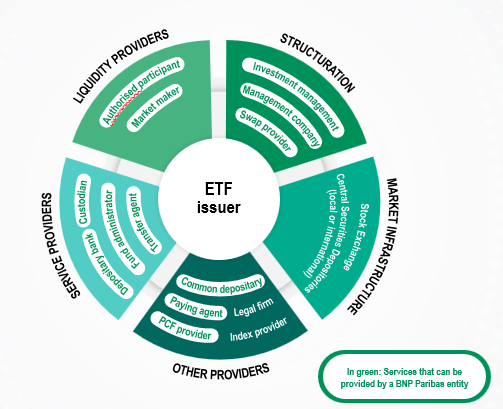
But something more fundamental is happening. ETFs are becoming a distribution channel which appeal to clients from institutions and central banks to individuals investing through an app. While the investors benefit from a seamless investment experience, ETF issuers need to build an ecosystem with multiple providers, from the structuration to the market infrastructures, liquidity and service providers.
Choosing the right model in the European ETF market
Europe offers ETF issuers considerable flexibility. A fund can be domiciled in one jurisdiction, listed on exchanges in several others and sold across a range of markets.
ETFs pave a new way for European investment funds

A structure that works for one asset manager may make little sense for another. The starting point should instead be the intended investors, investment strategy and the manager’s own capabilities.
Behind the ETF operating model,
ETFs also involve participants and processes that managers of traditional funds may be less accustomed to.
Authorised participants create and redeem ETF shares in the primary market. Market makers provide liquidity on exchanges. Both matter: even a sound investment proposition can struggle if investors face wide spreads.
Selecting liquidity providers is only the start. They must also interact with the asset manager, custodian, administrator, transfer agent, exchanges and other players.
ETFs have particular data and reporting requirements too. The portfolio composition file, for example, gives liquidity providers information they need to construct the baskets used for creations and redemptions. Processes that might run once a day for a traditional fund have to support a security traded throughout market hours. A weakness in one connection can therefore affect the whole ecosystem.
Building an efficient ETF ecosystem
Connectivity is crucial in the ETF world. In practice it has three dimensions, and a weakness in any one can undermine the rest:
- Process connectivity:
Creation and redemption, administration, settlement and related workflows need to fit together with few manual interventions or hand-offs. - Data connectivity:
Different participants and systems are unavoidable, but they need consistent information. Without it, errors, reconciliation failures and delays follow. - Market connectivity:
The links between the issuer and authorised participants, market makers, trading venues and other intermediaries through which the ETF reaches investors.
None works well in isolation. Efficient internal processing has limited value if market makers cannot obtain the information they need. Good market access cannot compensate for poor data or cumbersome settlement.
The point is not simply to connect more systems. Connectivity should allow information and transactions to move through the ETF chain with as little friction as possible.
Selecting the right ETF service provider
This raises a harder question about service providers. An issuer can assemble a group of specialists, each performing one part of the process. Or it can work with a broader provider able to cover several parts of the ETF chain. Both models have merits; what matters is finding the right fit. A manager with established infrastructure and relationships may want to retain much of what it has. A new entrant may put greater value on bringing more services together. Others will take a hybrid approach.
This makes modularity as important as breadth. Few managers want to replace systems or relationships that already work simply to fit a provider’s operating model. They need to select the components they require while connecting them with their own operations and those of third parties.
The most important question a manager must ask, therefore, is: which combination of capabilities gives us the simplest, most resilient and scalable model?
T+1 for ETFs: no room for error
That question will become more pressing when European markets move to T+1 settlement in October 2027. Cutting the settlement cycle from two business days to one leaves less time for allocation, confirmation, matching, funding and correcting exceptions. This is a particular challenge in Europe, where ETFs can span jurisdictions, markets and infrastructures.
Processes that work under T+2 may be less forgiving when the available time is halved. Automation, timely data and clear links between counterparties will matter more. T+1 is therefore more than a settlement project. It is also a test of how well the ETF ecosystem fits together.
Tokenisation: the next test for ETFs
Tokenisation could take this a stage further. ETFs are already suited to a more digital market structure. Unlike traditional funds, they trade intraday and depend on an ecosystem linking issuers, liquidity providers and investors. Tokenisation could extend those characteristics through near-instant execution and settlement, real-time information and, eventually, round-the-clock trading.
Experiments are moving from digital representations of conventional fund shares towards funds whose shares are issued directly on distributed ledgers. Yet conventional and tokenised structures are likely to coexist for some time, while different blockchains may do the same. Interoperability, rather than the technology alone, may therefore prove one of the main challenges.
Tokenisation will make connectivity even more critical for ETF issuers ETFs have succeeded partly by simplifying investing for end investors. Their next phase will require more sophisticated infrastructure to sustain that simplicity.


