



A continuation fund is a secondary vehicle established by private capital managers to transfer one or more assets from an existing fund nearing the end of its lifecycle in a bid to extend ownership beyond the original fund’s term.
Although not a new concept, the use of continuation funds has surged in recent years, driven by longer value creation timelines, rising investor demand for liquidity, and a rapidly evolving secondary market, making these vehicles a mainstream exit mechanism and liquidity provider across asset classes. This shift has provided sponsors with greater flexibility, enabling more efficient capital recycling and continued asset management.
While continuation funds can offer upside to both sponsors and investors, they are not without their challenges. These include managing conflicts of interest, the need for transparent valuation mechanisms, and varying levels of Limited Partner (LP) acceptance, all of which can create complexity. As the market for continuation funds develop, General Partners (GPs) must navigate these factors by delivering a well-defined investment rationale, and demonstrating alignment of interests between GPs and LPs.
Continued growth of GP-led secondaries
The GP-led secondary market has transitioned from a niche liquidity tool into a mainstream exit mechanism. Fuelled largely by the growth in continuation fund activity, GP-led transaction volume continues to grow, reaching approximately $65 billion in H1 2026, up 35% from H1 2025[1]. This marks a structural shift in the market. GP-led volume overtook LP-led volume for the first time since 2021 at 54% of secondary activity in H1 2026, while LP-led volume grew just 4% to $56bn. Secondaries dry powder has continued to grow, with availability of capital growing 5% between 2024 and 2025.
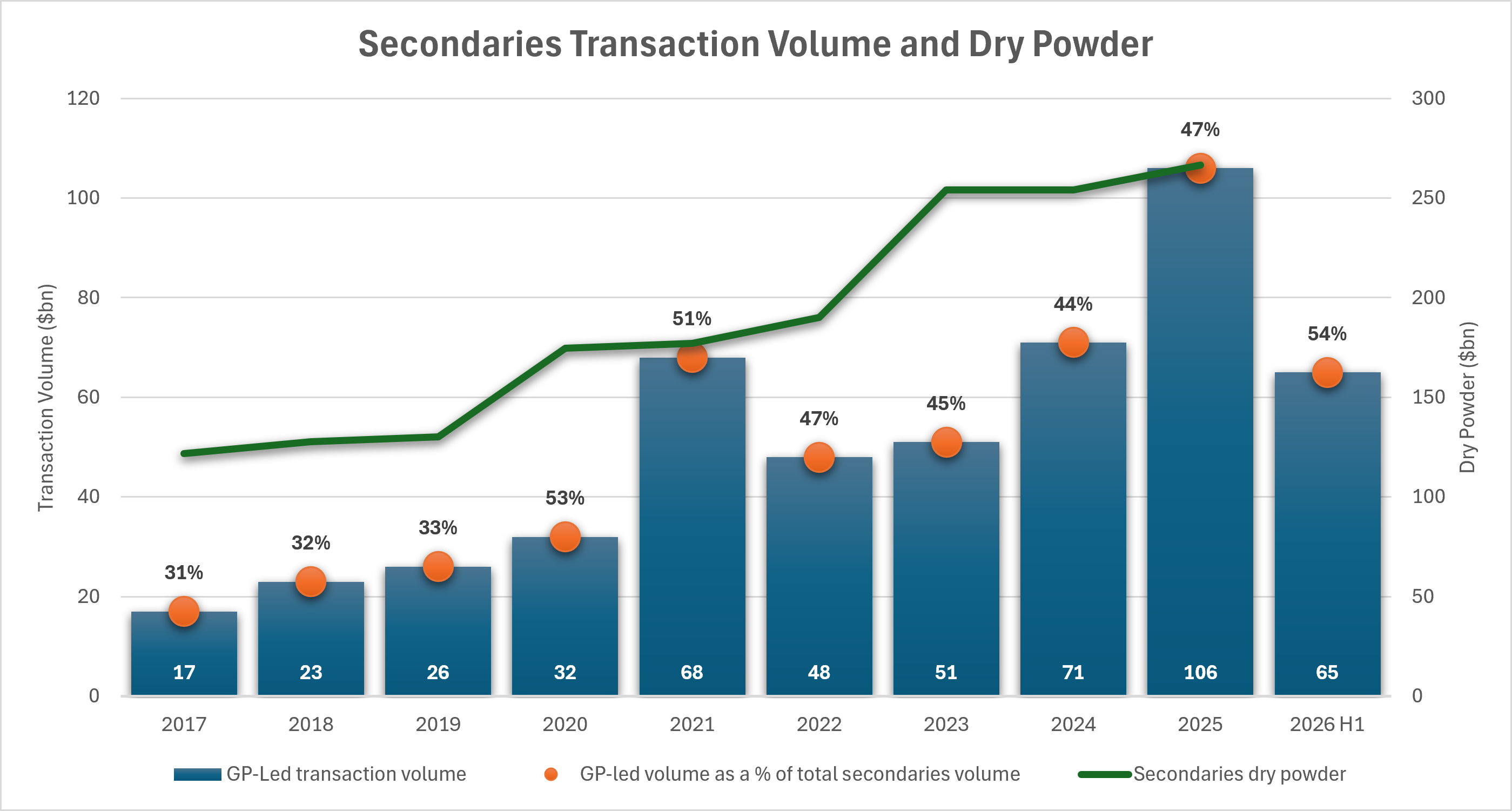
Source: Evercore, Preqin.
This growth is underpinned by a shift in market dynamics. Historically, extending management of a ‘trophy asset’ and generating liquidity for existing LPs in a low distribution environment were the key reasons for continuation funds.
However, the growth of the GP-led secondary market has been driven by multiple other factors. These include deeper capital availability across secondaries strategies driven by private wealth channels such as evergreen funds, increasing LP appetite due to familiarity and a widening investor base. Another key driver is the growth of use cases beyond private equity strategies across a wider spectrum of alternative asset classes. Private debt now accounts for 17% of continuation vehicles by 2026 vintage, growing substantially over the last few years.
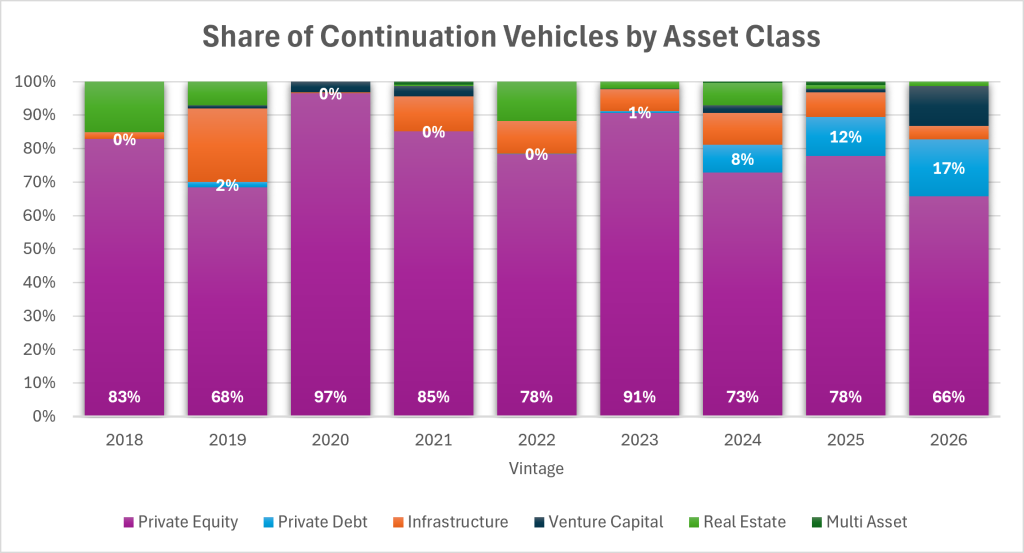
Source: Preqin. Vintages in 2026 are YTD data.
The upsides and complexities
Benefits for GPs and LPs
Continuation funds offer several distinct advantages across both private equity and private credit strategies, which have driven their increased adoption. While a fundamental driver for both is the provision of liquidity, the specific value proposition and practical applications differ, dictated by the asset-class nuances and the specific composition of the underlying portfolio.
In the private equity space, continuation vehicles are primarily tools for liquidity management and extending management of strategic assets:
- Extended Life of a Trophy Asset: For GPs, continuation funds provide an opportunity to extend the life of high-quality assets when market conditions or asset valuations may not support an attractive exit. This flexibility allows GPs to continue managing and optimising the asset, with the opportunity of realising greater value in the long term.
- Liquidity and Distribution to Paid-In (DPI): Providing liquidity to LPs by generating distributions, even without an asset exit, which is particularly beneficial for investors seeking liquidity in the absence of a traditional sale. However, it’s important to note that while continuation funds can generate liquidity, it is often considered artificial, as it doesn’t necessarily reflect a true exit from the asset.
- Increased Flexibility for LPs: LPs benefit from enhanced optionality as they are given the choice to either roll their stake into the continuation vehicle, potentially maintaining exposure to the asset as it matures, or sell their stakes, realising liquidity. This flexibility empowers LPs to align their portfolio strategies with their evolving investment goals.
For credit assets, the rationale shifts toward managing asset duration and optimising credit recovery:
- Managing Duration Mismatch: Loan tenors frequently extend beyond the fixed term of an originating private credit fund. This duration mismatch is driven by loan restructurings, refinancing requirements or contractual extensions. Loans that have been restructured or have breached covenants may carry equity-linked positions requiring continued active management. A continuation fund provides a vehicle to hold these assets beyond a fund’s original term.
- Liquidity Management: like private equity, credit continuation funds offer a liquidity option for existing LPs where illiquid credit assets have not reached their maturity. The vehicle facilitates a secondary sale, allowing LPs to exit their positions and realise value without waiting for the underlying loans to mature.
Whilst providing a range of benefits, continuation funds also introduce complexities and risks that both GPs and LPs must carefully manage. Key considerations such as valuation challenges, investor alignment, and market dynamics can significantly impact the success of the fund. If not addressed properly, these factors can pose obstacles to execution or even preventing the fund from launching successfully, with failed launches commonly attributed to misalignment between existing and new investors.
Private capital’s new frontier : The promises and challenges of continuation funds
Conflicts of interest
As the sponsor sits on both sides of the transaction, acting as both the seller from the existing fund and the buyer through the continuation vehicle, navigating conflicts of interest is critical.
- The sponsor must balance the interests of different investor groups, including those fully exiting, those rolling their stakes, and new investors entering the fund. This complexity is further heightened when existing structures, such as co-investment vehicles, are involved, as they may have different rights and expectations that need to be addressed.
- To attract capital for the continuation fund, sponsors often introduce additional incentives, such as stapled primary transactions, where investors commit to both the continuation vehicle and a new fund. However, as GPs have a duty to secure the best possible exit value for LPs in the existing fund while simultaneously seeking fresh capital for future investments, if not carefully managed, these dual objectives can lead to misalignment.
In cases where a GP clearly benefits from these types of transactions (through additional fees or a stappled commitment), the recommendation from the Institutional Limited Partners Association (ILPA)[2] is that the GP should clearly disclose these benefits.
ILPA’s proposed updated continuation fund guidance[2], issued in 2026, goes further, recommending that roll options should require stapled financing at all, and is accompanied by a Continuation Fund Disclosure Template covering valuation, conflicts management, fee and carry arrangements and stapled commitments.
Transaction economics and alignment
Achieving alignment between sponsors and investors is fundamental.
- Transparency is particularly important regarding fund terms and economics, for example whether carried interest from the original fund has been fully realised or if any portion is being rolled into the new vehicle. This carries additional weight in credit, where returns can be contractual and capped (compared to significant upside potential for private equity assets), therefore investors are typically more sensitive to the funds fees and expenses.
- Pricing can become a point of contention as GPs balance the interests of new and existing investors, with an independent valuation process typically necessary to prevent disputes between exiting and rolling LPs. While valuation is highly sensitive for equity assets and distressed credit strategies, it tends to be less contentious in performing credit strategies, where assets generally trade near par and exhibit lower volatility.
- Disclosures should be timely and comprehensive covering the selected assets, the rationale behind their transfer, the valuation process, any fairness opinion obtained
,and the bids received. The LP Advisory Committee (LPAC) plays a critical role in reviewing conflict waivers, while broader LP communication allows investors to make informed roll or exit decisions.
Private credit continuation funds: a different kind of vehicle
In the private credit space, several factors are driving increased adoption of continuation funds. Duration mismatches caused by loan restructurings increasingly need managing, and GPs need to hold assets through complex credit cycles. At the same time, evergreen structures and wealth management channels have expanded capital availability to the credit secondary market. Credit secondary volume has reached over $20bn in H1 2026, more than double H1 2025 and already ahead of the full-year 2025 total, with GP led transactions representing roughly 83% of that activity[1] .
Whilst there are synergies across private equity and credit strategies, there are fundamental differences in the composition and profile of these vehicles:
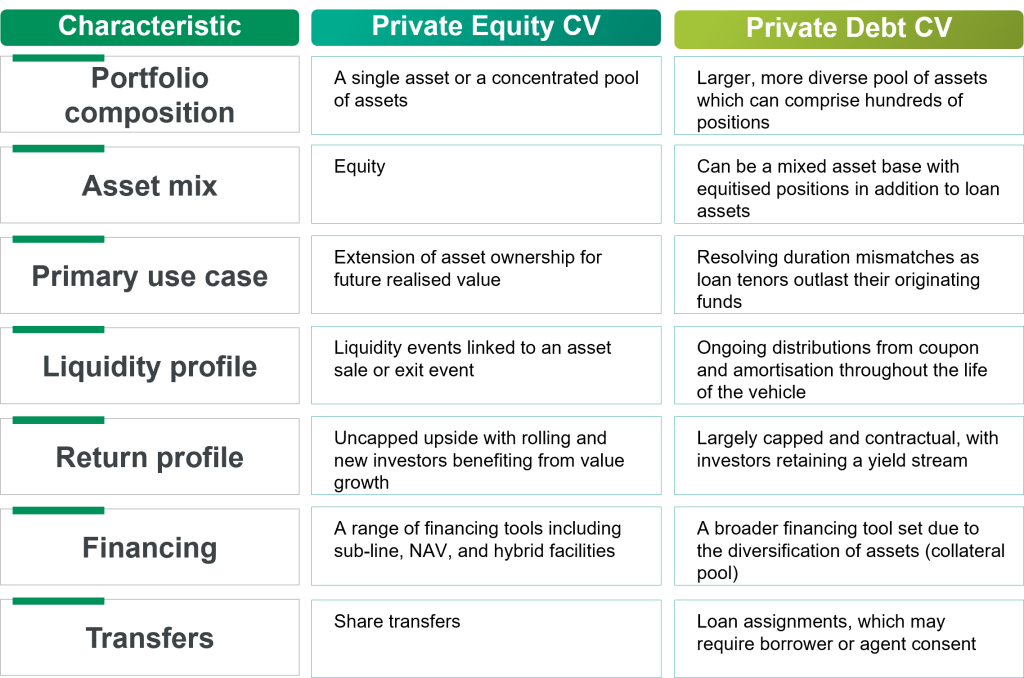
While the incentives of continuation funds are beginning to converge across asset classes, the underlying asset classes remain fundamentally distinct. For the private credit market, continuation funds are becoming more than just a liquidity tool, but a vehicle for navigating a maturing market.
Financing and security: an evolving landscape
Given the bespoke nature of continuation funds, tailored financing solutions are required, as traditional fund financing facilities and respective terms are often unsuitable. As a result, different structuring considerations are often considered which are determined by the continuation fund’s specific characteristics, such as the underlying assets and the investor composition.
A continuation fund can deploy a range of financing solutions, also commonly used in traditional private capital funds such as subscription lines or NAV facilities. However, as the asset pools in continuation funds can be limited and concentrated, they may require customised financing solutions:
- Hybrid facilities: Combining elements of both subscription and NAV facilities, hybrid facilities offer greater flexibility throughout the fund’s lifecycle. They are secured both by uncalled capital commitments and the underlying fund’s assets, giving lenders a broader collateral base. These facilities are more favoured by lenders due to the nature of the fund’s composition, typically a smaller pool of investors and a less diversified asset base, meaning the broader collateral base can enable lenders to spread risk and provide better pricing.
Where a continuation vehicle holds a credit portfolio, additional financing options are available. Granular, cash-generative loan portfolios support collateral discipline that a concentrated equity holding cannot, and lenders can size exposure against the portfolio rather than against a single valuation. Options include:
- Asset-backed portfolio financing: Asset-backed facilities advanced against the loan portfolio itself, structured around a borrowing base with defined eligibility criteria, advance rates and concentration limits, used for multiple purposes such as acquiring and/or refinancing assets, paying fees and expenses, and for broader working capital reasons.
- Asset-level and synthetic financing: Where financing is required for a small number of loans or for a single loan, single asset or line-by-line portfolio financing can be deployed, such as the use of loan total return swaps (Loan TRS).
Continuation fund financing serves a variety of strategic purposes, supporting both the operational needs of the fund, and the growth of the portfolio. This includes financing acquisitions for the initial asset/s transaction, providing additional liquidity to meet fund distributions or to cover a capital gap, and support portfolio growth initiatives where additional capital can be used for further investments such as follow-on investments in the portfolio.
Balancing opportunities and risks
As the market continues to develop across asset classes, we may see greater evolution across financial practices, for example across fund financing landscape, adoption across other asset classes, and continued growth in capital allocation. It will continue to remain vital that these funds have a robust investment rationale, GPs select the right asset(s), and conflicts of interest are managed effectively.
BNP Paribas offers one-stop shop asset servicing and financing solutions to GPs so they can scale and operate more efficiently. As a full-service bank active across the globe, we combine comprehensive solutions in fund administration, middle office, depositary, cash processing, financing and investor services reporting under one roof.
References
[1] Jeffries Global Secondary Market Review January 2025
[2] Continuation Funds: Considerations for Limited Partners and General Partners | Institutional Limited Partners Association